Introduction: Why Most SaaS Products Fail Before They Launch
The SaaS market is projected to exceed $900 billion by 2027, yet over 90 percent of SaaS startups fail within the first three years. The reason is rarely a bad idea. It is almost always a bad foundation. Founders rush to build features before they have designed a scalable architecture, chosen the right tech stack, or validated their core value proposition with real users. The result is a product that works in demos but collapses under real-world conditions.
At The DIGIT HQ, we have architected and shipped dozens of SaaS platforms across industries ranging from healthcare to real estate to education technology. This guide distills that experience into a comprehensive, actionable roadmap that covers every phase of SaaS development, from the initial concept to your first paying customers and beyond.
Whether you are a non-technical founder evaluating development partners or a CTO planning your next product, this article will give you the engineering perspective you need to make informed decisions at every stage.
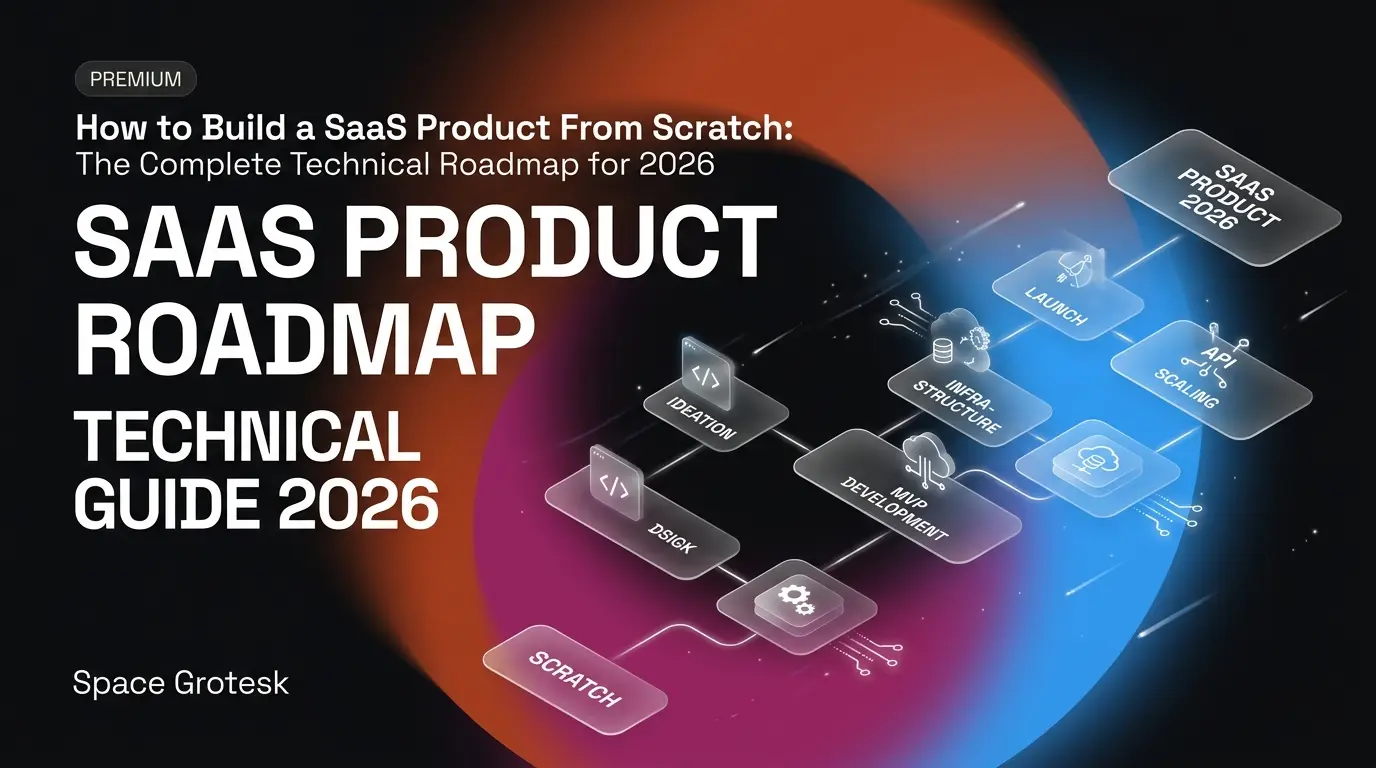
Phase 1: Product Discovery and Market Validation
Before writing a single line of code, you need to validate that your product solves a real problem that people will pay to solve. This is not about building a landing page and running ads. It is about deep market research and competitive analysis that informs your technical decisions.
At The DIGIT HQ, our Product Discovery and MVP Lab process begins with what we call a Technical Feasibility Audit. We analyze your target market, identify the core workflows your product must support, and map out the technical complexity of each feature. This allows us to prioritize ruthlessly: what goes into the MVP, what gets deferred to version two, and what should never be built at all.
The output of this phase is a Product Requirements Document (PRD) that serves as the single source of truth for your entire development team. It includes user personas, core user flows, data models, API requirements, and a prioritized feature backlog. Without this document, you are building in the dark.
Key Questions to Answer Before Building
- What is the single most painful workflow your product eliminates?
- Who are your first 100 customers, and where do they currently spend money on this problem?
- What is the minimum set of features that delivers enough value to charge for?
- Can your product be built with standard web technologies, or does it require specialized infrastructure?
- What are the data privacy and compliance requirements for your target market?
Phase 2: Choosing the Right Tech Stack
Your tech stack is the foundation of everything. The wrong choice here will cost you months of rework and hundreds of thousands in wasted engineering hours. The right choice will accelerate your development, reduce your operational costs, and give you a platform that scales gracefully.
For the majority of SaaS products, we recommend a PHP/Laravel backend paired with a modern reactive frontend. Laravel provides an extraordinary ecosystem for SaaS-specific features: multi-tenancy, queue management, task scheduling, API authentication with Sanctum, payment processing with Cashier, and real-time broadcasting with Reverb. These are not add-ons. They are battle-tested, first-party packages maintained by the Laravel core team.
For products that require real-time collaboration, live dashboards, or WebSocket-heavy functionality, we architect hybrid systems that combine Laravel for business logic with Node.js for real-time communication layers. This gives you the best of both worlds: Laravel's robust ORM and middleware for your core application, and Node.js's event-driven architecture for real-time features.
Database Architecture for Multi-Tenant SaaS
Multi-tenancy is the defining architectural decision for any SaaS product. You have three options: shared database with tenant IDs, separate schemas per tenant, or separate databases per tenant. Each has profound implications for data isolation, performance, and operational complexity.
For most early-stage SaaS products, we recommend starting with a shared database architecture using tenant-scoped queries. This is the simplest to build, the cheapest to operate, and sufficient for the vast majority of use cases. As you scale beyond thousands of tenants, you can introduce schema separation or database sharding without rewriting your application logic, provided your data access layer is properly abstracted from the start.
Phase 3: Building the MVP
The MVP is not a prototype. It is a fully functional, production-ready application that delivers your core value proposition with zero compromise on reliability, security, or performance. The only thing you are minimizing is scope, not quality.
Our SaaS Product Development methodology breaks the MVP into three-week sprint cycles with continuous staging deployments. At the end of each sprint, you have a working, testable version of your product that you can put in front of real users.
Essential SaaS MVP Components
- Authentication and Authorization: Multi-role user management with email verification, password reset, and session management. We implement this with Laravel Sanctum for API-based authentication and role-based access control (RBAC) using Spatie Permission.
- Subscription and Billing: Stripe or Paddle integration with plan management, usage tracking, invoice generation, and webhook handling. Laravel Cashier handles the heavy lifting, but custom metering logic is always required for usage-based pricing models.
- Admin Dashboard: A comprehensive back-office interface for managing users, viewing analytics, and configuring system settings. We build these as separate SPA modules using React or Vue.js.
- API Layer: A well-documented RESTful API that serves your frontend and enables future third-party integrations. Every endpoint is versioned, authenticated, and rate-limited from day one.
- Notification System: Email, in-app, and push notification infrastructure with template management and delivery tracking.
Phase 4: Quality Assurance and Security
A SaaS product handles sensitive customer data. There is no room for amateur-hour security or untested code paths. Our Quality Assurance and Resilience Testing process includes automated unit testing, integration testing, load testing, and comprehensive security audits.
We write automated tests for every critical user flow: registration, login, subscription management, data CRUD operations, and payment processing. We use PHPUnit for backend testing, Cypress for end-to-end browser testing, and custom load testing scripts to simulate thousands of concurrent users hammering your API endpoints.
Security is not a feature. It is a non-negotiable baseline. We implement OWASP Top 10 protections, enforce HTTPS everywhere, sanitize all user inputs, implement Content Security Policy headers, and conduct regular dependency vulnerability scans. For SaaS products handling healthcare, financial, or education data, we implement additional compliance controls for HIPAA, PCI-DSS, or FERPA as required.
Phase 5: Deployment and DevOps Infrastructure
Your deployment pipeline is just as important as your application code. A manual deployment process introduces risk, delays, and human error into every release cycle. Our Cloud and DevOps Solutions team builds fully automated CI/CD pipelines that take your code from a Git commit to a production deployment in minutes, not hours.
We typically deploy SaaS applications on AWS or DigitalOcean using containerized environments with Docker. Infrastructure is defined as code using Terraform, which means your entire server configuration is version-controlled, reproducible, and auditable. Need to spin up a staging environment that mirrors production exactly? It is a single command.
Monitoring and Observability
Once your SaaS product is live, you need to know what is happening inside it at all times. We implement comprehensive monitoring that covers application performance, error tracking, database query analysis, and infrastructure health. Laravel Telescope provides development-time debugging, while production monitoring is handled by tools like Sentry for error tracking and custom dashboards for business metrics.
Phase 6: Launch, Growth, and Scaling
Launching a SaaS product is not the finish line. It is the starting line. Your first customers will reveal edge cases, feature gaps, and performance bottlenecks that no amount of pre-launch testing can predict. The key is having the technical infrastructure to respond quickly.
For organic growth, we recommend investing in Search Engine Optimization from day one. Your marketing site, documentation, and blog content should be architected for search visibility. We build SaaS marketing sites with clean semantic HTML, proper heading hierarchies, structured data markup, and performance-optimized asset delivery.
For paid acquisition, our Digital Marketing and Growth Engineering team builds data-driven campaigns that target high-intent keywords and optimize for customer acquisition cost (CAC) against lifetime value (LTV).
Real-World Implementation: Case Studies
Our engineering approach to SaaS development is best demonstrated through recent implementations. The Speed Index: Search Discovery SaaS Platform showcases our ability to build complex, data-intensive SaaS products with real-time processing capabilities. This platform handles millions of URL indexing requests with sub-second response times, demonstrating the scalability of our architecture decisions.
Similarly, the EduNexis Growth Platform illustrates our approach to building multi-tenant SaaS products in the education technology space. This platform serves thousands of concurrent users with complex role hierarchies, content management workflows, and analytics dashboards, all built on the Laravel ecosystem we described in this guide.
For healthcare SaaS, our work on Vitalis-65: Preventive Health and Longevity Platform demonstrates how we handle compliance-sensitive environments while maintaining the rapid development velocity that startups require.
Conclusion: Build It Right the First Time
Building a SaaS product is a significant investment of time, capital, and engineering talent. The decisions you make in the first three months of development will determine your product's trajectory for years. Cutting corners on architecture, security, or infrastructure is not saving money. It is creating technical debt that compounds with every new feature and every new customer.
At The DIGIT HQ, we specialize in building SaaS products that are engineered for the long term. If you are planning a SaaS product and want an architecture review from a team that has built and shipped dozens of them, get in touch with us. We will help you avoid the expensive mistakes and build a product that scales with your ambition.