
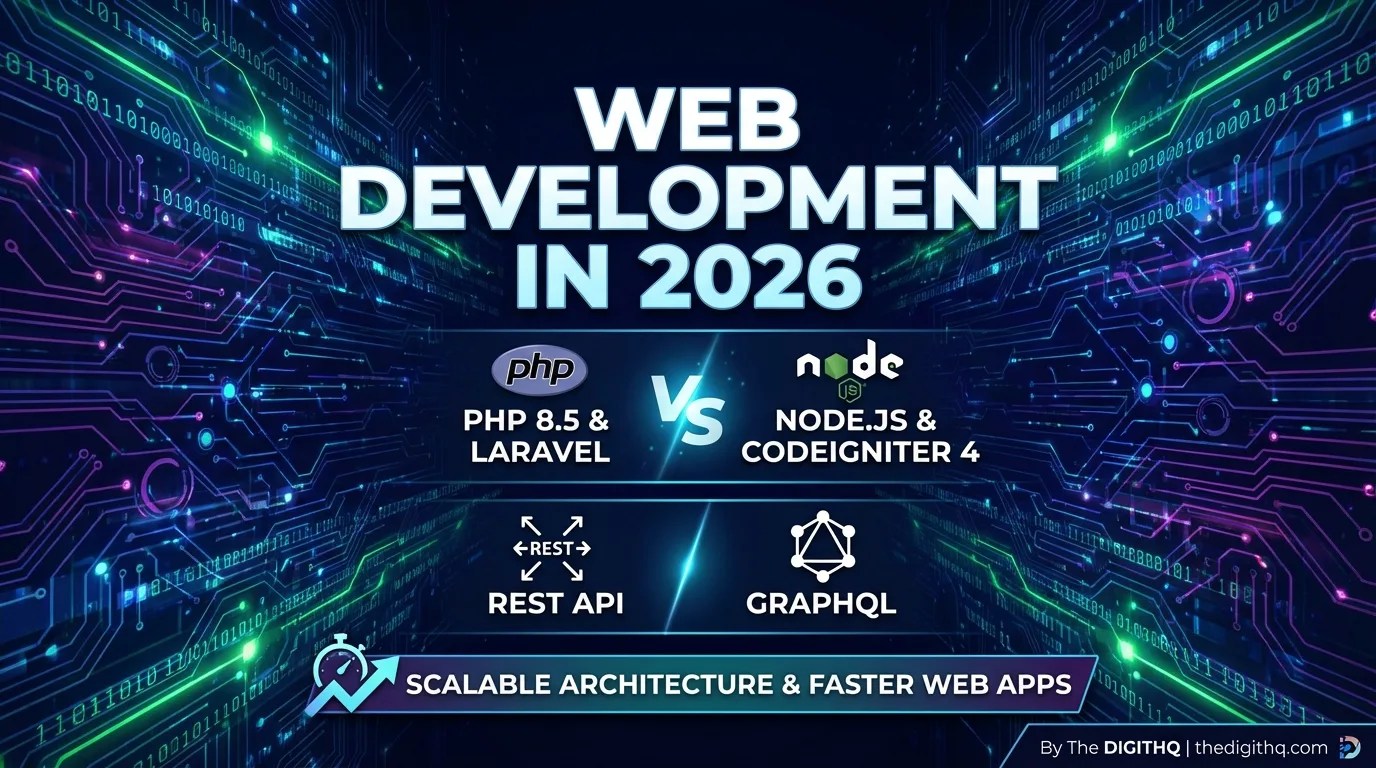
Introduction: Why Your Backend Choice Defines Your Product's Future
Web development is not a single decision - it is a sequence of decisions that compound over time. The frameworks you choose, the architecture you design, the APIs you build, and the performance standards you set in the early stages of a product will either support your growth or quietly become the ceiling you cannot break through.
In 2026, the web development landscape is more powerful than ever - and more complex. Founders and CTOs now face a stack of critical questions before writing a single line of production code:
• Should we build our backend in PHP or Node.js?
• Is Laravel the right choice, or would CodeIgniter 4 serve us better?
• How do we design a system that can scale from 100 users to 100,000?
• Should we use REST APIs or switch to GraphQL?
• And how do world-class agencies achieve sub-second load times?
This article answers all of those questions - in plain language, backed by real engineering experience. At The DIGIT, we have built and shipped hundreds of web applications across industries. This is not theory. This is what we use, what we recommend, and what actually works at scale.
1. PHP 8.x vs Node.js - Which Backend Should You Pick in 2026?
This is the most common technical question we hear from founders evaluating their backend stack. Both PHP and Node.js are mature, production-tested technologies. Both have massive ecosystems. Both can power high-traffic applications. The question is not which one is 'better' in absolute terms - it is which one is right for your specific project.
What PHP 8.x Brings to the Table
PHP has undergone a complete transformation over the past decade. PHP 8.x, released in late 2023, is not the scripting language from the early 2000s. It is a modern, typed, performant language with fibers for concurrency, readonly classes, union types, named arguments, match expressions, and JIT (Just-In-Time) compilation.
PHP 8.x performance benchmarks show it processing over 1,500 requests per second in typical web workloads - a 3x improvement over PHP 7 when combined with modern frameworks like Laravel. The language is now statically typed where needed, object-oriented by design, and remarkably fast when properly configured with OPcache.
More importantly, PHP's server model - where each request spawns in isolation - makes it extraordinarily easy to scale horizontally. There is no shared memory to worry about, no event loop to corrupt, and no long-running process to crash in production.
What Node.js Brings to the Table
Node.js is built on Google's V8 JavaScript engine and operates on a non-blocking, event-driven architecture. This means a single Node.js process can handle thousands of simultaneous connections - making it exceptional for real-time features like live chat, collaborative editing, push notifications, and WebSocket-heavy applications.
Node.js also means your frontend and backend teams share the same language - JavaScript - which reduces context-switching, enables code sharing between client and server, and can significantly speed up development when your team is already fluent in JavaScript.
|
Factor |
PHP 8.x |
Node.js |
|
Language Style |
Multi-paradigm, typed |
JavaScript (async) |
|
Best For |
Content platforms, e-commerce, SaaS dashboards |
Real-time apps, APIs, chat systems |
|
Concurrency Model |
Multi-process (per-request isolation) |
Single-threaded event loop |
|
Learning Curve |
Low to medium |
Medium (async patterns) |
|
Ecosystem |
Composer, Laravel, Symfony |
npm (largest package registry) |
|
Hosting Availability |
Extremely wide (shared, VPS, cloud) |
VPS, cloud, serverless |
|
Performance (web workloads) |
1,200–1,800 req/sec (with OPcache) |
15,000+ req/sec (I/O bound tasks) |
|
Production Maturity |
30+ years, highly stable |
15+ years, highly stable |
The DIGITHQ Recommendation: For content-driven platforms, SaaS products, and e-commerce systems - PHP 8.x with Laravel is our default choice. For real-time features - dashboards with live data, collaborative tools, or WebSocket-heavy systems - Node.js is the clear winner. Many of our projects use both.
2. Laravel vs CodeIgniter 4 - Choosing the Right PHP Framework
If you have decided that PHP is the right backend for your project, your next decision is which framework to use. Laravel and CodeIgniter 4 are both excellent choices - but they serve different types of projects and teams. Choosing the wrong one will cost you time, budget, and engineering headaches.
Laravel: The Full-Stack PHP Powerhouse
Laravel is the most popular PHP framework in the world, and for good reason. It is an opinionated, batteries-included framework that provides everything a modern web application needs: authentication, authorization, database ORM (Eloquent), task scheduling, queue management, email, event broadcasting, file storage, and much more - all out of the box.
Laravel's greatest strength is developer experience. The framework is thoughtfully designed, richly documented, and backed by a massive ecosystem of first-party packages (called Laravel Forge, Telescope, Horizon, Sanctum, Passport, Cashier, and more). When your team adopts Laravel, they inherit years of battle-tested conventions that prevent reinventing the wheel.
Laravel is the right choice when:
• You are building a complex SaaS application with multiple user roles
• Your product requires background job queues, task scheduling, or event broadcasting
• You need a built-in admin panel, API authentication, or payment integration
• Your team will grow over time and you need strong architectural conventions
• You want long-term maintainability with clear separation of concerns
CodeIgniter 4: The Lightweight, Blazing-Fast Alternative
CodeIgniter 4 (CI4) is a lightweight, un-opinionated PHP framework focused on simplicity and raw performance. It has a tiny footprint - the core framework is under 2MB - and imposes far fewer conventions on your team. This makes it highly flexible: you design the architecture, you choose what to include, and you control every layer.
CI4 is significantly faster than Laravel in pure benchmark tests because it loads less overhead per request. For applications where every millisecond counts - high-traffic APIs, data processing endpoints, simple web portals - CI4's performance advantage is real and measurable.
CodeIgniter 4 is the right choice when:
• You are building a lightweight web app or REST API with minimal complexity
• Performance and low memory footprint are critical requirements
• Your team prefers minimal convention and maximum control
• You are working on a legacy CodeIgniter project and need modern CI compatibility
• You need a simple, fast backend without the learning curve of a full framework
|
Factor |
Laravel |
CodeIgniter 4 |
|
Framework Size |
Full-featured (~30MB install) |
Lightweight (~2MB core) |
|
Performance |
Good (with optimization) |
Excellent (minimal overhead) |
|
Learning Curve |
Medium (rich conventions) |
Low (minimal conventions) |
|
Built-in Features |
Authentication, queues, jobs, broadcasting, ORM |
Routing, ORM, sessions, validation |
|
Ecosystem |
Massive (Forge, Horizon, Telescope, Cashier) |
Moderate |
|
Best Project Type |
Complex SaaS, multi-role platforms, full products |
APIs, lightweight apps, portals |
|
Community Size |
Very large (global) |
Large (growing) |
|
The DIGITHQ Usage |
70% of our projects |
30% of our projects |
At The DIGITHQ, we default to Laravel for most client projects because of its long-term maintainability. We reach for CodeIgniter 4 when the client needs maximum speed with minimal overhead - particularly for high-traffic public APIs and content delivery systems.
3. Building Scalable Web Apps: Architecture Decisions That Save You Later
The most expensive engineering mistake a startup can make is building a system that works perfectly at 500 users and breaks catastrophically at 5,000. Scalability is not something you retrofit after the fact - it is a series of architectural decisions you make before you write your first controller.
We have rebuilt systems from scratch for clients who came to us after outgrowing their original architecture. The pattern is always the same: the first version was built fast, the founders were happy, and then traffic grew. Without scalable foundations, every new feature became harder, every deployment became risky, and every spike in traffic became a crisis.
Here are the architecture decisions that separate systems that scale from systems that buckle.
Decision 1: Stateless Application Design
A stateless application does not store session data, user context, or request state in application memory. Instead, all state is stored externally - in a database, a Redis cache, or a session store. This is the single most important decision for horizontal scalability.
When your application is stateless, you can run 2 servers, 20 servers, or 200 servers - and a load balancer can send requests to any of them. No user is 'stuck' on one server. When traffic spikes, you add servers. When traffic drops, you remove them. This is cloud-native scaling.
Decision 2: Database Architecture - Vertical vs Horizontal
Most small applications start with a single relational database (MySQL or PostgreSQL). This works well up to a point. As you grow, you will face a choice: scale vertically (bigger server) or scale horizontally (multiple servers).
Vertical scaling is easy but has a ceiling. Horizontal scaling - using read replicas, database sharding, or moving to a distributed system - is complex but has no ceiling. Our recommendation:
• Use a primary database for writes and read replicas for heavy read queries
• Implement database query caching with Redis or Memcached for repeated queries
• Use database indexing aggressively - this alone can speed queries by 100x
• Plan for data partitioning early if you expect tens of millions of records
Decision 3: Queue Everything That Does Not Need to Be Synchronous
A common performance bottleneck in web applications is doing too much work during the HTTP request lifecycle. Sending emails, generating PDFs, resizing images, calling third-party APIs, sending notifications - none of these need to happen before the user sees a response.
Move all of these into background job queues. In Laravel, this is native with Laravel Queues and Laravel Horizon. In Node.js, use Bull or BullMQ. The result: your application responds in milliseconds, and the heavy work happens asynchronously in the background.
Decision 4: CDN and Static Asset Delivery
Every image, CSS file, JavaScript bundle, and font that your application serves from your origin server is a wasted opportunity. A Content Delivery Network (CDN) - such as Cloudflare, AWS CloudFront, or Fastly - serves these assets from data centers that are geographically close to your users.
The impact is dramatic: a user in London accessing a UKi server will experience 200ms+ latency on every asset. The same user accessing a Cloudflare edge node in Frankfurt will experience under 10ms. This is not marginal - it is the difference between a fast product and a frustrating one.
Decision 5: Caching Strategy
Caching is the highest-leverage performance investment you can make. A properly cached response takes microseconds to serve instead of milliseconds or seconds. There are multiple caching layers to consider:
• Application-level caching: Cache expensive database queries and computed values in Redis
• HTTP caching: Use cache-control headers to let browsers cache static responses
• Full-page caching: For public pages, cache the entire rendered HTML output
• API response caching: Cache third-party API responses to reduce latency and API costs
The DIGITHQ builds every web application with scalability as a first-class concern - not an afterthought. If you are planning a new web product, we offer a free architecture review to identify scalability risks before they become expensive problems. Visit thedigithq.com to book a consultation.
4. REST API vs GraphQL - A Decision Guide for Non-Technical Founders
If you are building a modern web application, mobile app, or multi-platform product, you need an API layer - a standardized interface through which your frontend, mobile app, and third-party integrations communicate with your backend. The two dominant API paradigms today are REST and GraphQL.
Most founders encounter these terms without a clear explanation of what they mean in practice. Let us break it down.
What is a REST API?
REST (Representational State Transfer) is an architectural style for building APIs using standard HTTP methods. In a REST API, each resource - a user, a product, an order - has its own URL endpoint, and you interact with it using HTTP verbs: GET to read, POST to create, PUT to update, DELETE to remove.
REST APIs are extremely well-understood, widely supported, and have a massive ecosystem of tools, clients, and documentation standards. If you have ever integrated with Stripe, Twilio, Shopify, or any modern SaaS platform - you have used a REST API.
What is GraphQL?
GraphQL is a query language for APIs, developed by Facebook (now Meta) and released as open-source in 2015. Instead of fixed endpoints, GraphQL exposes a single endpoint where the client specifies exactly what data it needs - no more, no less.
Imagine you are building a mobile app that shows a user's name, their latest 3 orders, and their profile photo. With a REST API, you might need 3 separate requests: GET /user, GET /orders?limit=3, GET /user/avatar. With GraphQL, you make a single query requesting exactly those three fields in one round trip.
|
Factor |
REST API |
GraphQL |
|
Concept |
Multiple endpoints, fixed responses |
Single endpoint, flexible queries |
|
Data Fetching |
May over-fetch or under-fetch data |
Fetch exactly what you need |
|
Multiple Resources |
Multiple requests required |
Single query for all resources |
|
Caching |
Easy (HTTP caching works natively) |
Complex (requires custom caching) |
|
Learning Curve |
Low - widely understood |
Medium - requires schema design |
|
Tooling |
Extremely mature (Postman, Swagger) |
Growing (Apollo, Hasura, GraphiQL) |
|
Best For |
Simple CRUD apps, third-party integrations |
Complex UIs, mobile apps, multi-platform |
|
Performance |
Predictable, easy to optimize |
Flexible, but can be abused |
When Should You Choose REST?
• You are building a straightforward web application with simple data requirements
• Your API will be consumed by third-party developers or public integrations
• Your team is more familiar with REST conventions
• You need simple, HTTP-level caching without extra infrastructure
• You are integrating with third-party services that expect REST-style webhooks
When Should You Choose GraphQL?
• You are building a mobile app where minimizing data transfer is critical
• Your frontend is complex with many different views that need different data shapes
• You have multiple client types (web, iOS, Android) with different data needs
• You want your frontend team to work independently without waiting for new API endpoints
• Your product has a complex, interconnected data model with many relationships
The DIGITHQ's take: REST is right for 80% of the projects we build. GraphQL becomes compelling when you have a complex, multi-platform product with a dedicated frontend team. We are experienced in both - and we will recommend the right choice for your specific situation, not the trendy one.
5. How We Achieve Sub-Second Load Times: Our Performance Engineering Checklist
Page speed is not a vanity metric. Google's Core Web Vitals use page speed as a direct ranking signal. Conversion research consistently shows that a 1-second delay in page load time results in a 7% reduction in conversions. For an e-commerce store turning over £50,000 a month, that is £3,500 in lost revenue - from a single second of lag.
At The DIGITHQ, we have developed a battle-tested performance engineering checklist that we run on every project before launch. Here is what it looks like.
Frontend Performance
• Minimize and compress all CSS and JavaScript using modern build tools (Vite, Webpack, esbuild)
• Implement lazy loading for all images below the fold
• Use next-generation image formats (WebP, AVIF) with appropriate fallbacks
• Remove render-blocking scripts - defer or async all non-critical JavaScript
• Implement Critical CSS - inline the CSS needed for above-the-fold content
• Use a CDN to serve all static assets from edge locations close to your users
• Set far-future cache headers on versioned static assets
Backend Performance
• Profile every database query - eliminate N+1 query problems with eager loading
• Add database indexes to every column used in WHERE, JOIN, and ORDER BY clauses
• Implement Redis caching for expensive queries and repeated computations
• Use connection pooling to reuse database connections instead of creating new ones
• Move background tasks (emails, reports, notifications) to async queues
• Enable PHP OPcache (for PHP projects) to cache compiled bytecode
• Use HTTP/2 or HTTP/3 for multiplexed request delivery
Infrastructure Performance
• Use a reverse proxy like Nginx to serve static files directly - never route them through PHP
• Enable Gzip or Brotli compression at the server level
• Configure Cloudflare or equivalent CDN for DNS-level caching and DDoS protection
• Set up server-side monitoring (New Relic, Datadog, or open-source alternatives)
• Use a geographically distributed deployment if your users are across multiple regions
Measurement and Monitoring
• Run Google PageSpeed Insights before and after every deployment
• Monitor Core Web Vitals: LCP (Largest Contentful Paint), FID, CLS
• Set up uptime monitoring with alerts for any downtime over 1 minute
• Implement application performance monitoring to catch slow endpoints before users do
Following this checklist is how we consistently deliver web applications with Largest Contentful Paint scores under 1.2 seconds and Google PageSpeed scores above 90 on mobile. Performance is not magic - it is engineering discipline applied consistently.
Why Founders and CTOs Choose The DIGITHQ for Web Development
The DIGITHQ is a precision-engineered digital agency based in UK, working with clients across the Middle East, Europe, the United Kingdom, and North America. We specialize in building production-grade web applications using PHP 8.x, Laravel, CodeIgniter 4, and Node.js - and we bring the same engineering standards that power enterprise products to projects of every size.
Here is what makes us different:
• We have built 500+ web applications and automation systems across industries
• We have helped clients achieve 2.4 million indexed URLs through technical SEO
• Our average client engagement lasts 18+ months - we become your long-term technology partner
• We offer end-to-end services: architecture design, development, performance optimization, SEO, and AI integration
• We are transparent about timelines, costs, and trade-offs - we never oversell and underdeliver
Whether you are evaluating your backend stack, planning a new web product, dealing with performance issues, or looking for a technical team to trust - we would love to talk.
🚀 Ready to build something exceptional?
Visit thedigithq.com for a free consultation.
We respond within 24 hours.
FAQ - Web Development Questions Answered
What is web development and what does it involve?
Web development is the process of building and maintaining websites and web applications. It covers frontend development (what users see and interact with), backend development (the server, database, and business logic), and the infrastructure that keeps everything running. Modern web development also includes API design, performance optimization, security hardening, and scalability planning.
Which backend language is best for a startup in 2026?
For most startups, PHP 8.x with Laravel is the most practical choice - it is fast to build with, has excellent documentation, and has a massive pool of developers. If your product requires real-time features or you are building a heavily API-driven application consumed by mobile clients, Node.js is a strong alternative. The best choice depends on your team's expertise and your product's specific requirements.
How long does it take to build a custom web application?
A simple web application with a few core features typically takes 8–12 weeks. A medium-complexity SaaS product with authentication, dashboards, and integrations typically takes 3–6 months. Enterprise-grade platforms with complex workflows, multi-tenancy, and extensive integrations can take 6–18 months. At The DIGITHQ, we provide detailed project timelines with milestones before any work begins.
What is the difference between REST and GraphQL?
REST APIs use multiple fixed endpoints - one per resource type - and return predefined data structures. GraphQL uses a single endpoint where the client specifies exactly what data it needs. REST is simpler and more widely supported; GraphQL is more flexible and efficient for complex, multi-platform products. Both are production-ready choices; the right one depends on your use case.
How do I make my web application faster?
The highest-impact performance improvements are: using a CDN for static assets, caching database queries with Redis, optimizing images (format and lazy loading), eliminating N+1 database queries, and enabling server-side compression. These five steps alone can reduce load times by 60–80% in most applications. At The DIGITHQ, we offer performance audits that identify the specific bottlenecks in your application.
What is scalable web architecture?
Scalable web architecture means designing your application so that it can handle growth - in users, traffic, and data - without requiring a complete rebuild. Key principles include stateless application design, horizontal scaling capability, database read replicas and caching, asynchronous background job processing, and CDN-backed asset delivery. Scalability is a design philosophy, not a feature you add later.
Conclusion
Web development in 2026 is a rich, nuanced discipline. The choices you make - backend language, framework, API design, architecture - have real consequences for your product's performance, your team's productivity, and your business's ability to grow.
The good news is that none of these decisions have to feel overwhelming when you have the right partner. At The DIGITHQ, we have navigated these decisions hundreds of times, across dozens of industries, for clients ranging from early-stage startups to established enterprises.
If you are planning a new web product, evaluating your existing architecture, or simply want a second technical opinion - we are here to help. No sales pitch, no jargon, no pressure. Just honest, expert guidance from engineers who have built it all before.
THE DIGITHQ
Precision-Engineered Digital Agency
thedigithq.com
Web Development · AI & Automation · SEO · Design · AI Development