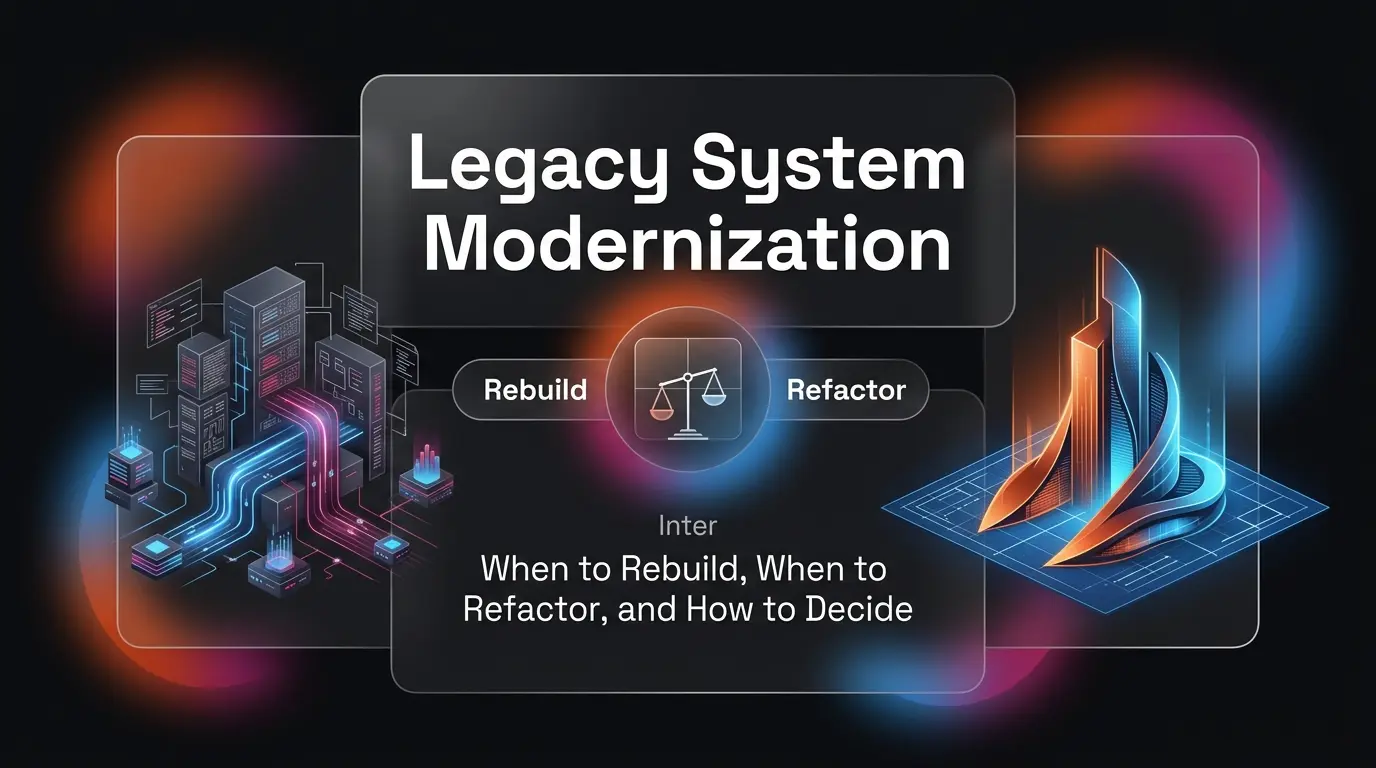
Introduction: The Technical Debt Time Bomb
Every business that has been operating for more than five years has legacy technology. It might be a custom CRM built in PHP 5, an e-commerce platform running on an unsupported framework, or an internal tool held together by duct tape and prayers. These systems work. They process orders, manage customers, and keep the business running. But they are ticking time bombs.
Legacy systems accumulate technical debt over time: quick fixes that bypass proper architecture, deprecated libraries that no longer receive security patches, and undocumented features that only one developer understands. Eventually, the cost of maintaining the legacy system exceeds the cost of replacing it. The question is not whether to modernize. It is when and how.
At The DIGIT HQ, we specialize in modernizing legacy systems without disrupting the business operations that depend on them. This article provides a practical decision framework for determining the right modernization strategy for your specific situation.
Understanding Your Legacy System
Before making any modernization decisions, you need a clear-eyed assessment of your current system. This means understanding not just its technical limitations, but its business value, its data assets, and the organizational dependencies that have built up around it over the years.
Technical Assessment
- Code Quality: Is the codebase well-structured and documented, or is it a monolithic mess with no clear architecture? Can your current team understand and modify it confidently?
- Framework and Language Currency: Is the underlying framework still actively maintained? Are security patches available? Can you hire developers who know this technology?
- Performance Baseline: What are the current response times, error rates, and scalability limits? Where are the performance bottlenecks?
- Security Posture: Are there known vulnerabilities in the framework, libraries, or custom code? When was the last security audit?
- Test Coverage: Does the system have automated tests? If not, how do you verify that changes do not break existing functionality?
Business Assessment
- Revenue Dependency: How much revenue flows through this system? What is the cost per hour of downtime?
- User Base: How many internal and external users depend on this system daily?
- Integration Landscape: What other systems integrate with this one? What would break if you replaced it?
- Data Assets: What data does this system hold, and how critical is it? Can it be easily extracted and migrated?
Strategy 1: Incremental Refactoring (The Strangler Fig Pattern)
Incremental refactoring is the lowest-risk modernization strategy. Instead of replacing the entire system at once, you gradually replace individual components while keeping the legacy system running. This is often called the "Strangler Fig Pattern" after the tropical vine that slowly grows around and replaces its host tree.
When to Choose Refactoring
- The legacy system's core architecture is sound, but individual components are outdated.
- The system handles critical business processes that cannot tolerate significant downtime.
- You have limited budget and need to spread the modernization cost over multiple quarters.
- The data model is well-designed and does not need fundamental changes.
How We Implement It
We start by identifying the highest-risk or highest-value component and rebuilding it as a standalone module that integrates with the legacy system via APIs. Once the new component is stable and validated, we route traffic to it and retire the corresponding legacy code. We repeat this process module by module until the entire system has been modernized.
Strategy 2: Full Rebuild (The Clean Slate)
A full rebuild means designing and building a new system from scratch, then migrating data and users from the legacy system to the new one. This is the highest-risk strategy but sometimes the only viable option.
When to Choose Rebuilding
- The legacy system's architecture is fundamentally flawed and cannot be incrementally improved.
- The underlying technology is completely obsolete and no longer receives security patches.
- The codebase is undocumented, untested, and understood by no one currently on your team.
- Your business requirements have changed so dramatically that the existing system cannot accommodate them.
How We Implement It
We build the new system in parallel with the legacy system, using modern frameworks like Laravel or CodeIgniter 4. We implement a comprehensive data migration pipeline that maps legacy data structures to the new schema. We run both systems simultaneously during a transition period, validating data consistency and functional parity before cutting over. Our Cloud and DevOps team ensures zero-downtime deployment during the cutover.
Strategy 3: Hybrid Approach (The Most Common Choice)
In practice, most modernization projects use a hybrid approach: rebuilding the core application while preserving and refactoring valuable components. This balances the risk reduction of incremental refactoring with the architectural benefits of a clean rebuild.
Data Migration: The Hidden Complexity
Data migration is where most modernization projects encounter unexpected complexity. Legacy systems often have inconsistent data formats, missing validation, duplicated records, and undocumented relationships between tables. A successful migration requires thorough data profiling and cleansing before migration begins, mapping documents that define how every legacy field translates to the new schema, automated migration scripts with rollback capabilities, and validation procedures that verify data integrity after migration.
We build our Business Intelligence capabilities into the migration process, creating dashboards that track migration progress, data quality metrics, and post-migration validation results in real time.
Risk Mitigation: Protecting the Business During Modernization
The biggest risk in any modernization project is disrupting the business operations that depend on the legacy system. We mitigate this risk through parallel running of both systems during the transition period, feature parity validation using automated comparison testing, staged rollout that migrates users in cohorts rather than all at once, instant rollback capability that can revert to the legacy system within minutes if issues are detected, and comprehensive monitoring that alerts our team to any anomalies during and after the transition.
Case Studies: Successful Modernizations
Our portfolio includes numerous successful legacy modernization projects. The AetherRE platform demonstrates our ability to modernize complex data-intensive systems while preserving critical business logic and historical data integrity. This project involved migrating years of accumulated data into a modern, performant architecture without any loss of business continuity.
For clients requiring ongoing support after modernization, our Strategic SaaS Maintenance service provides continuous monitoring, security patching, and iterative improvements that keep your newly modernized system current and performant.
Making Your Decision
If you are running a legacy system that is becoming increasingly expensive to maintain, increasingly risky from a security perspective, or increasingly limiting from a business capability perspective, now is the time to evaluate your modernization options. The longer you wait, the more technical debt accumulates, and the more expensive and risky the eventual modernization becomes.
Contact The DIGIT HQ for a complimentary legacy system assessment. We will evaluate your current system, identify the highest-priority modernization opportunities, and recommend a strategy that balances risk, cost, and business impact.