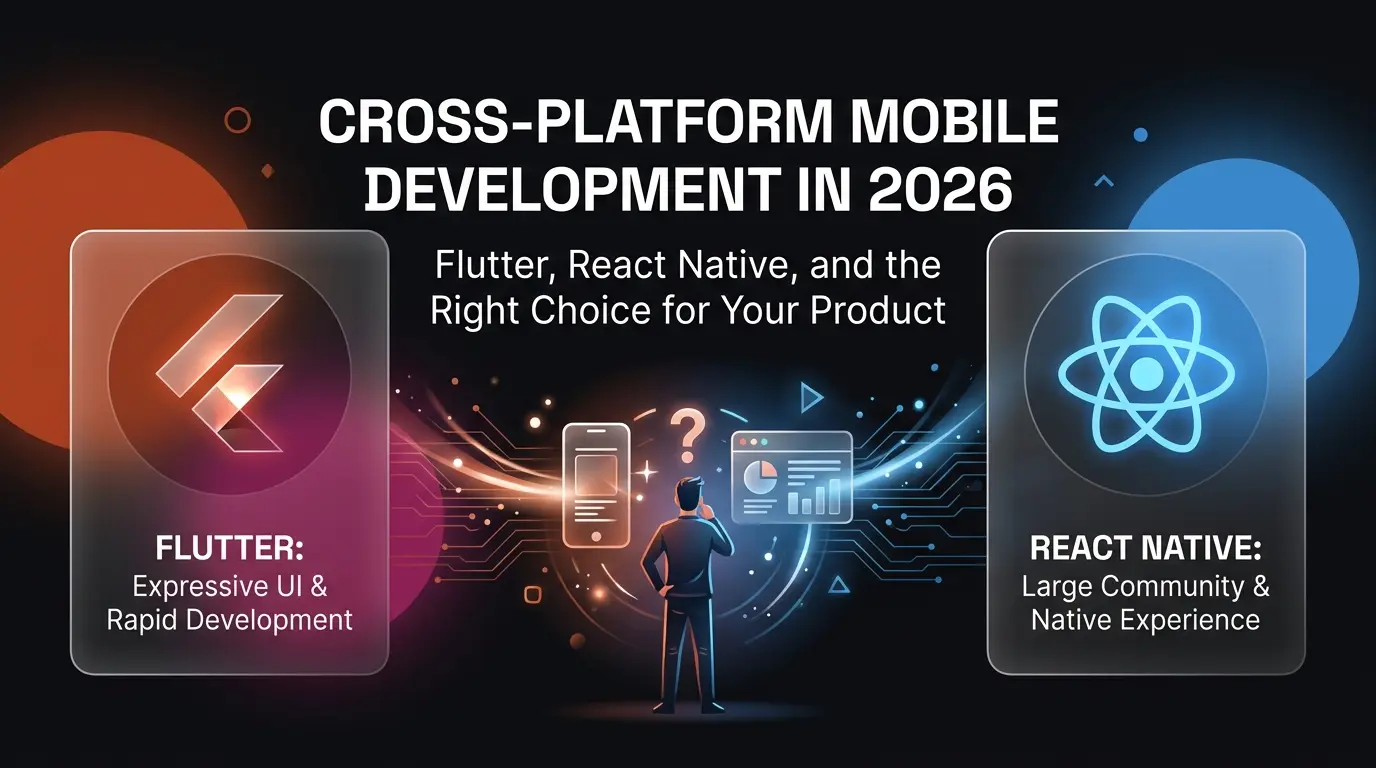
Introduction: The End of the Native vs Cross-Platform Debate
For years, mobile development was defined by a binary choice: build native apps for iOS and Android separately (doubling your development cost and timeline), or use a cross-platform framework and accept significant compromises in performance and user experience. In 2026, that trade-off has largely disappeared.
Modern cross-platform frameworks, specifically Flutter and React Native, have matured to the point where they deliver near-native performance, full access to platform APIs, and user experiences that are indistinguishable from native apps to the vast majority of users. The question is no longer whether to go cross-platform. It is which cross-platform framework is right for your specific product.
At The DIGIT HQ, we have shipped production mobile applications with both Flutter and React Native across industries including healthcare, finance, education, and e-commerce. This article provides an honest, engineering-driven comparison to help you make the right choice.
Flutter: Google's UI Toolkit for Beautiful, Natively Compiled Apps
Flutter is Google's open-source UI toolkit for building natively compiled applications from a single codebase. Unlike React Native, which renders using native platform components, Flutter uses its own rendering engine (Skia, and more recently Impeller) to draw every pixel on screen. This gives Flutter complete control over the visual output, which translates to pixel-perfect consistency across platforms.
Why Choose Flutter
- Visual Consistency: Because Flutter draws its own UI, your app looks identical on iOS and Android. There are no platform-specific rendering differences to debug.
- Performance: Flutter compiles to native ARM code, delivering smooth 60fps (and often 120fps) animations. The Impeller rendering engine eliminates the shader compilation jank that plagued earlier Flutter versions.
- Widget System: Flutter's composable widget architecture makes it easy to build complex, custom UI components. Everything in Flutter is a widget, which provides a consistent mental model for developers.
- Hot Reload: Flutter's hot reload preserves application state while reflecting code changes in under a second. This dramatically accelerates the development feedback loop.
- Multi-Platform Expansion: Flutter now supports web, macOS, Windows, and Linux in addition to iOS and Android. If you anticipate expanding beyond mobile, Flutter provides a single codebase path to all platforms.
Flutter Considerations
- Dart is less widely known than JavaScript, which can impact hiring and team ramp-up time.
- Flutter's custom rendering means apps do not automatically adopt platform-specific design patterns (Material vs Cupertino). You need to explicitly implement platform-aware UI if you want your app to feel "native" on each platform.
- The Flutter package ecosystem, while growing rapidly, is smaller than React Native's npm ecosystem.
React Native: Meta's JavaScript Framework for Native Mobile Apps
React Native, developed by Meta (formerly Facebook), allows you to build mobile apps using JavaScript and React. Unlike Flutter, React Native renders using actual native platform components, which means your app automatically inherits the look and feel of each platform.
Why Choose React Native
- JavaScript Ecosystem: React Native leverages the massive JavaScript and npm ecosystem. If you have an existing web team using React, they can be productive in React Native with minimal ramp-up.
- Native Component Rendering: React Native uses actual iOS and Android UI components, which means your app automatically looks and behaves like a native app on each platform.
- Code Sharing with Web: If you are building both a web application and a mobile app, React Native allows significant code sharing with your React web codebase, including business logic, API clients, and state management.
- Mature Ecosystem: React Native has been in production use since 2015, giving it a mature ecosystem of libraries, tools, and community resources.
- New Architecture: React Native's new architecture (Fabric renderer, TurboModules, and the JSI bridge) has resolved the performance limitations of the old architecture, delivering significant improvements in startup time and interaction responsiveness.
Head-to-Head Comparison
Rather than declaring a winner, let us compare the frameworks across the dimensions that matter most for production applications: performance, developer experience, ecosystem, and long-term viability.
Performance
Both frameworks deliver excellent performance for the vast majority of applications. Flutter has a slight edge in animation-heavy UIs and complex custom rendering due to its direct control over the rendering pipeline. React Native has improved dramatically with the new architecture and now matches Flutter in most real-world scenarios.
Developer Experience
Flutter's hot reload is faster and more reliable than React Native's Fast Refresh, giving it an edge in development velocity. However, React Native's use of JavaScript means a larger pool of available developers and easier hiring.
Ecosystem and Libraries
React Native benefits from the enormous npm ecosystem and has more third-party libraries available. Flutter's pub.dev ecosystem is growing rapidly but is smaller. For most common use cases (navigation, state management, networking, storage), both frameworks have mature, well-maintained solutions.
Our Recommendation Framework
After building production apps with both frameworks, here is our decision framework:
Choose Flutter when: Your app has complex, custom UI requirements. You need pixel-perfect visual consistency across platforms. You plan to expand to web, desktop, or embedded platforms. You are starting with a new team and can invest in Dart training.
Choose React Native when: Your team already knows JavaScript and React. You need maximum code sharing with an existing React web application. You want your app to feel "native" on each platform with minimal customization. Hiring and team scaling are priority concerns.
Case Studies: Mobile Apps We Have Built
Our mobile development portfolio demonstrates our expertise across both frameworks. The Apex AutoCare Hub mobile experience was engineered with performance-first principles, delivering sub-second navigation transitions and seamless booking flows that increased mobile conversion rates significantly.
For NurtureCare OB/GYN Platform, we built a patient-facing mobile application that handles sensitive health data with enterprise-grade security while providing an intuitive, calming user experience appropriate for expectant mothers navigating complex healthcare workflows.
Beyond the Framework: What Actually Matters
The framework you choose matters far less than how you use it. Clean architecture, comprehensive testing, performance monitoring, and a focus on user experience are what separate great mobile apps from mediocre ones. At The DIGIT HQ, we bring that engineering discipline to every mobile project regardless of the framework.
If you are planning a mobile app and want expert guidance on framework selection and architecture, contact us for a free technical consultation.