Project Overview
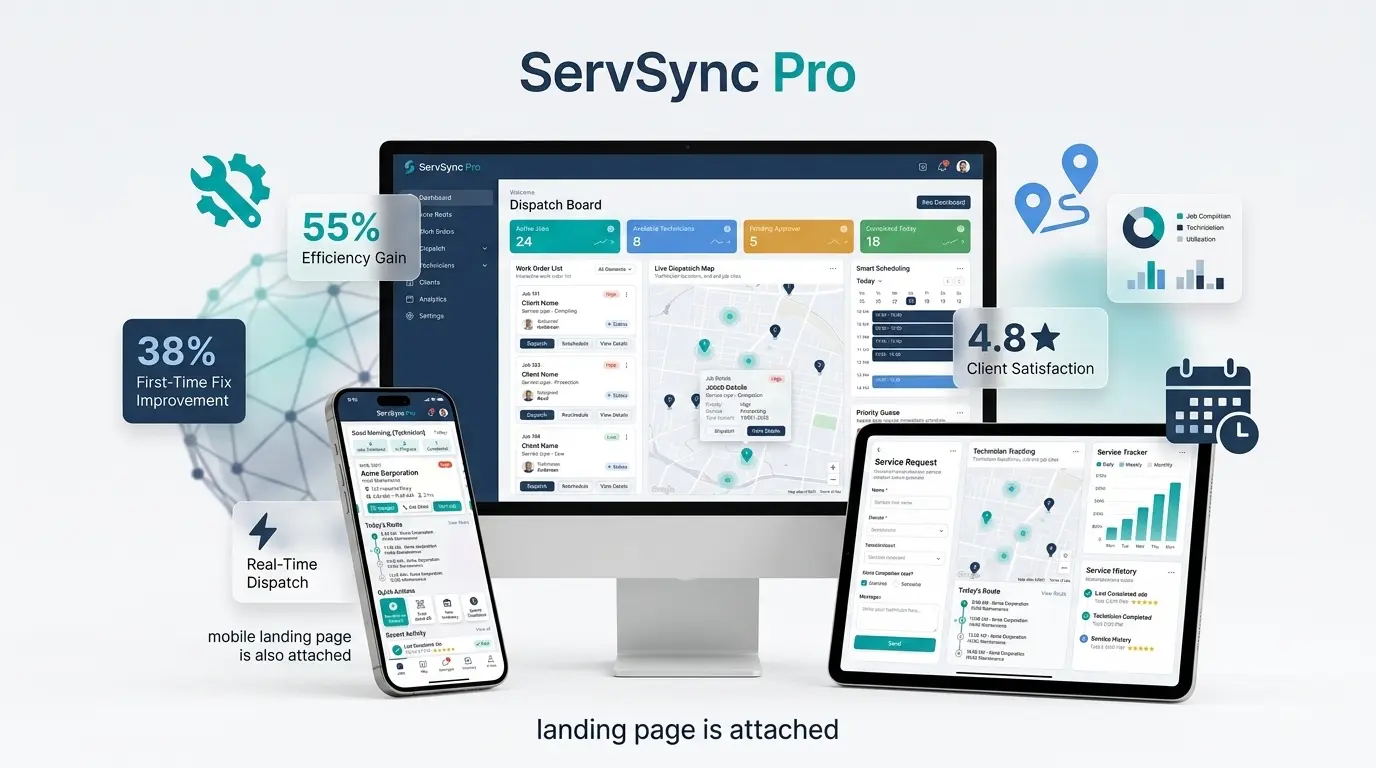
We engineered ServSync Pro to dismantle the operational fragmentation paralyzing Apex Facility Solutions Group’s 150+ client portfolio. Previously anchored to disconnected spreadsheets, manual paper workflows, and reactive SMS dispatch, the organization faced escalating administrative bottlenecks, a 30% manual data-entry error rate, and a measurable decline in client trust. Our team architected a unified, cloud-native service management CRM that synchronizes field operations, intelligent dispatch, and client communication into a single decision-ready ecosystem. By prioritizing offline-first mobile access and real-time WebSocket synchronization, we bridged the critical connectivity gap between centralized operations and distributed field technicians. The platform delivers precise resource allocation, automated SLA compliance tracking, and algorithmic scheduling, fundamentally shifting Apex from reactive firefighting to proactive maintenance orchestration.
Strategic Pillars:
• Centralized work order lifecycle management with sub-100ms retrieval
• Real-time technician routing and predictive capacity planning
• Seamless office-to-field data synchronization
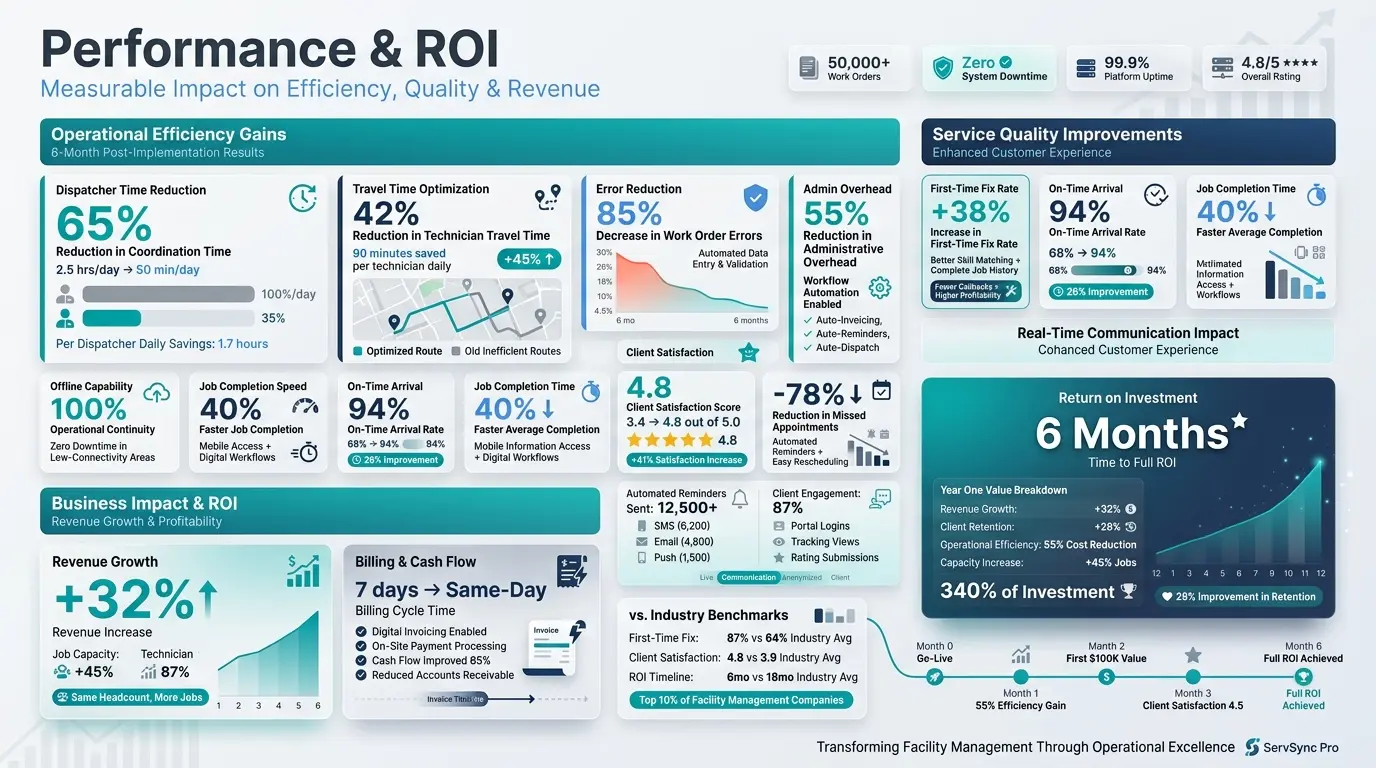
Within six months of deployment, the architecture reduced administrative overhead by 55%, accelerated first-time fix rates by 38%, and compressed billing cycles to same-day execution, establishing a scalable foundation for sustained operational excellence.
The Challenge
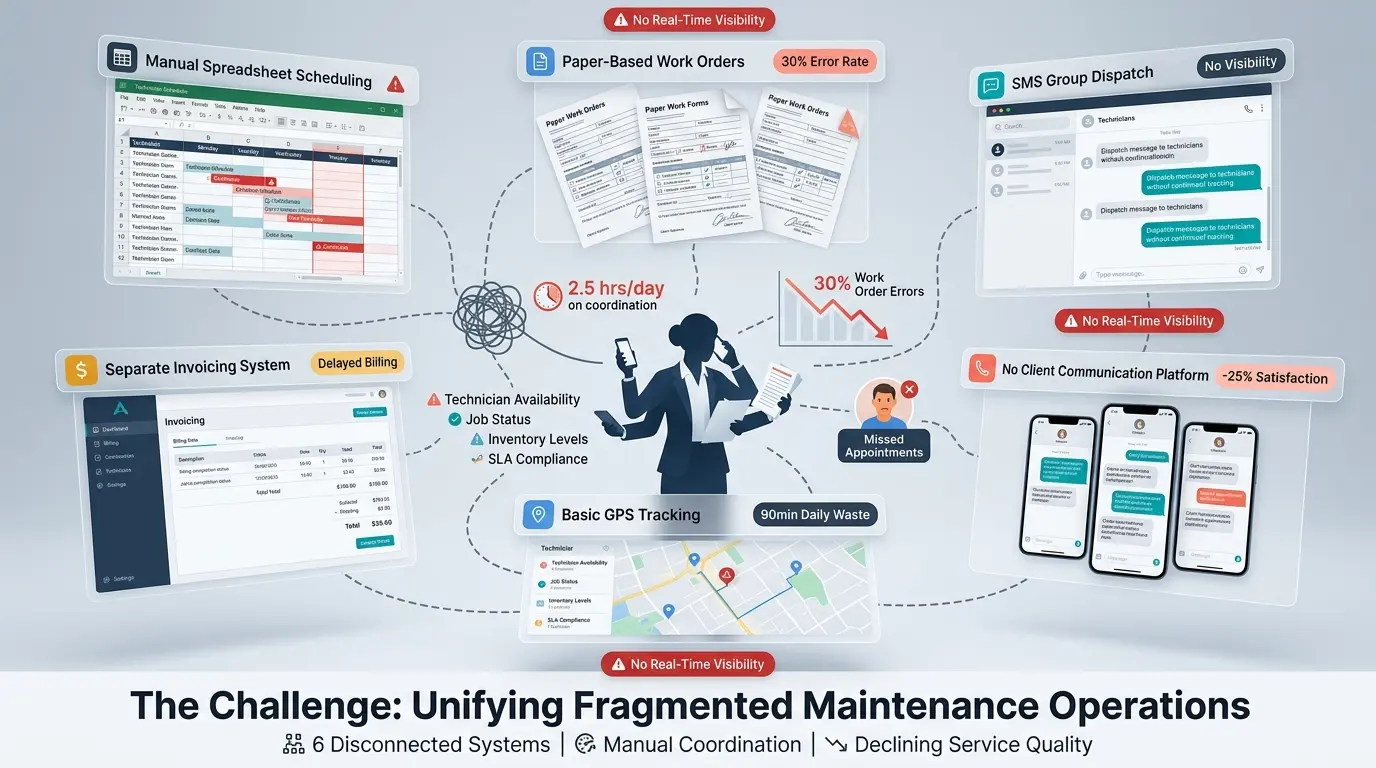
Apex Facility Solutions Group operated across a fractured technological landscape that actively eroded profitability and service reliability. Dispatchers dedicated 2.5 hours daily to manual coordination, while technicians lost 90 minutes to inefficient routing. The absence of a unified communication layer meant missed appointments, delayed invoicing, and zero real-time visibility into field status. Our mandate was clear: replace six disconnected legacy systems with a cohesive, enterprise-grade platform capable of handling multi-skilled technician coordination, emergency response protocols, and strict SLA compliance, all while functioning reliably in low-connectivity zones.
Operational Mandates:
• Elimination of manual spreadsheet scheduling and paper work orders
• Consolidation of isolated invoicing, dispatch, and client communication channels
• Implementation of real-time GPS tracking and route optimization
• Deployment of robust offline-first architecture for continuous field operations
Technical Architecture
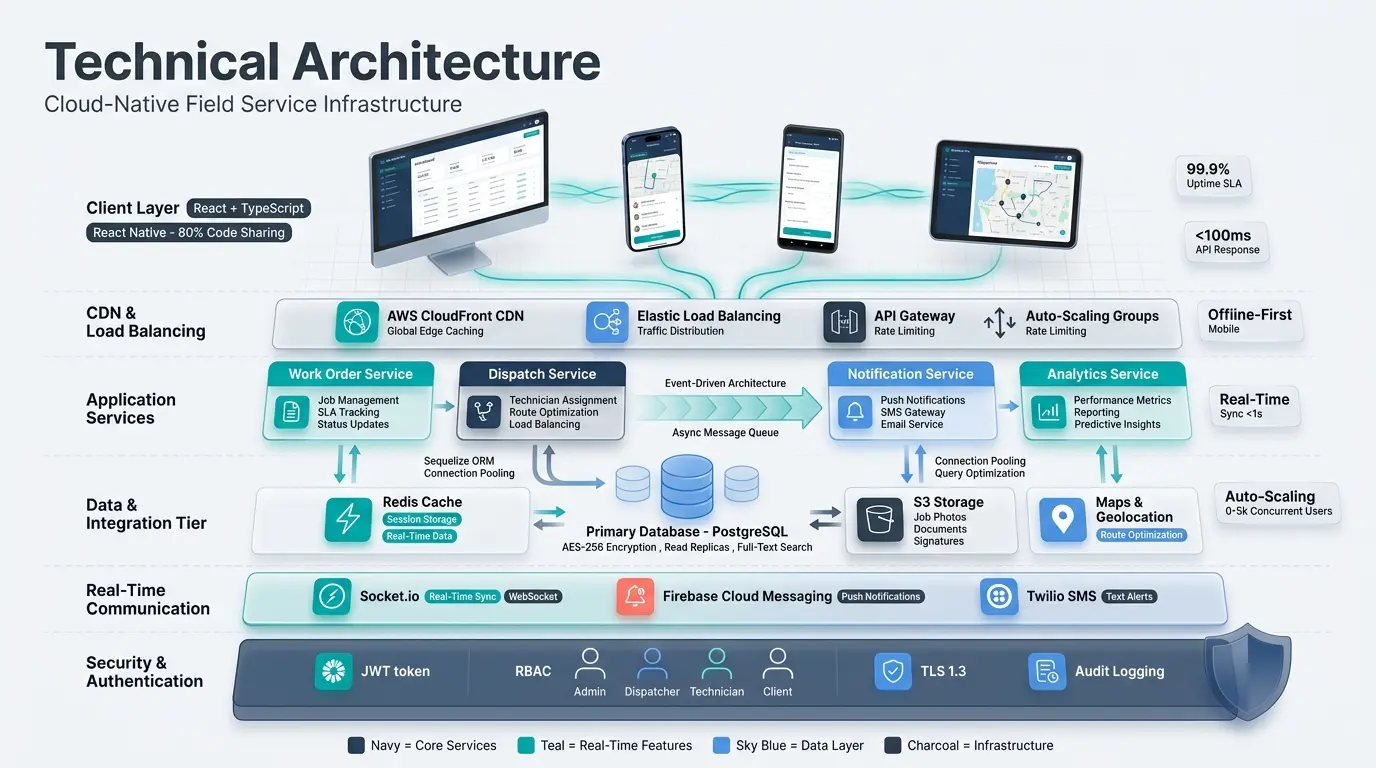
We constructed a cloud-native, microservices-ready architecture designed explicitly for high-concurrency field service demands. The system leverages AWS infrastructure with auto-scaling capabilities, utilizing PostgreSQL as the primary relational database for complex work order and client data relationships. Redis handles session management and high-frequency caching, while Socket.io powers bidirectional WebSocket streams for live technician tracking and instant dispatch updates. The frontend operates on React with TypeScript for rigorous type safety across complex scheduling algorithms, paired with React Native to achieve 80% code sharing across iOS and Android technician and client applications. Data persistence employs AES-256 encryption at rest and TLS 1.3 in transit, secured by JWT authentication with granular role-based access control.
Infrastructure Core:
• RESTful API and GraphQL endpoints with optimized query routing
• Real-time bidirectional communication via WebSocket streams
• Integrated geolocation services and route optimization engines
• Secure, encrypted storage for job documentation and digital signatures
Engineering Process
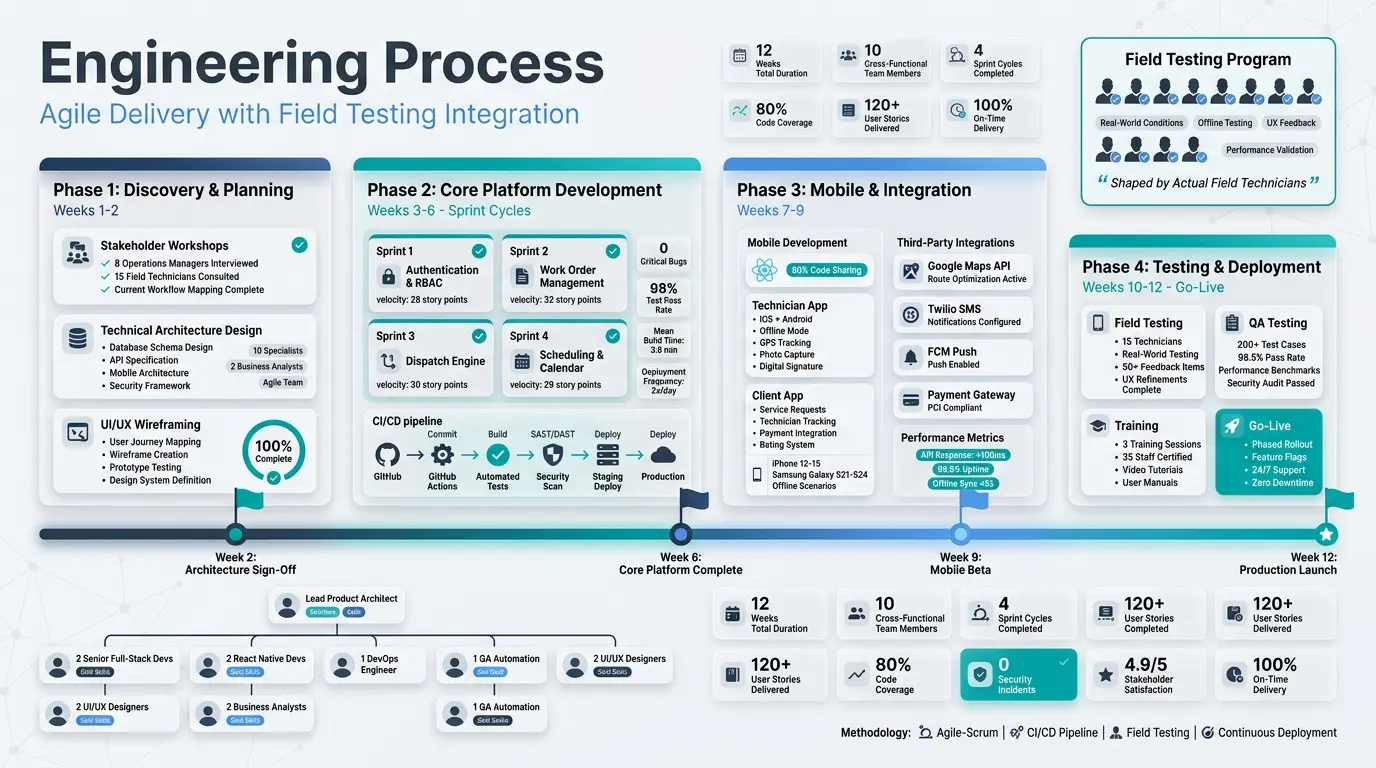
Our delivery methodology adhered to a customized Agile-Scrum framework structured across a disciplined 12-week sprint cycle. A cross-functional squad of 10 specialists—including full-stack engineers, mobile developers, UI/UX designers, and DevOps architects—executed four sequential phases: Discovery & Planning, Core Platform Development, Mobile App & Integration, and Testing & Deployment. We embedded continuous integration and deployment pipelines via GitHub Actions, enforcing 80% test coverage and automated security scanning at every commit. Crucially, we launched a dedicated Field Testing Program during Weeks 8–10, deploying the mobile application to 15 active technicians operating under real-world conditions. This direct field validation loop allowed us to refine offline sync logic and UX touch targets before production rollout.
Delivery Framework:
• Four-phase sprint structure with bi-weekly stakeholder alignment
• Automated CI/CD pipelines with integrated security and performance benchmarks
• Real-world field testing with 15 active service technicians
• Feature-flagged phased rollout ensuring zero-downtime deployment
Product Capabilities
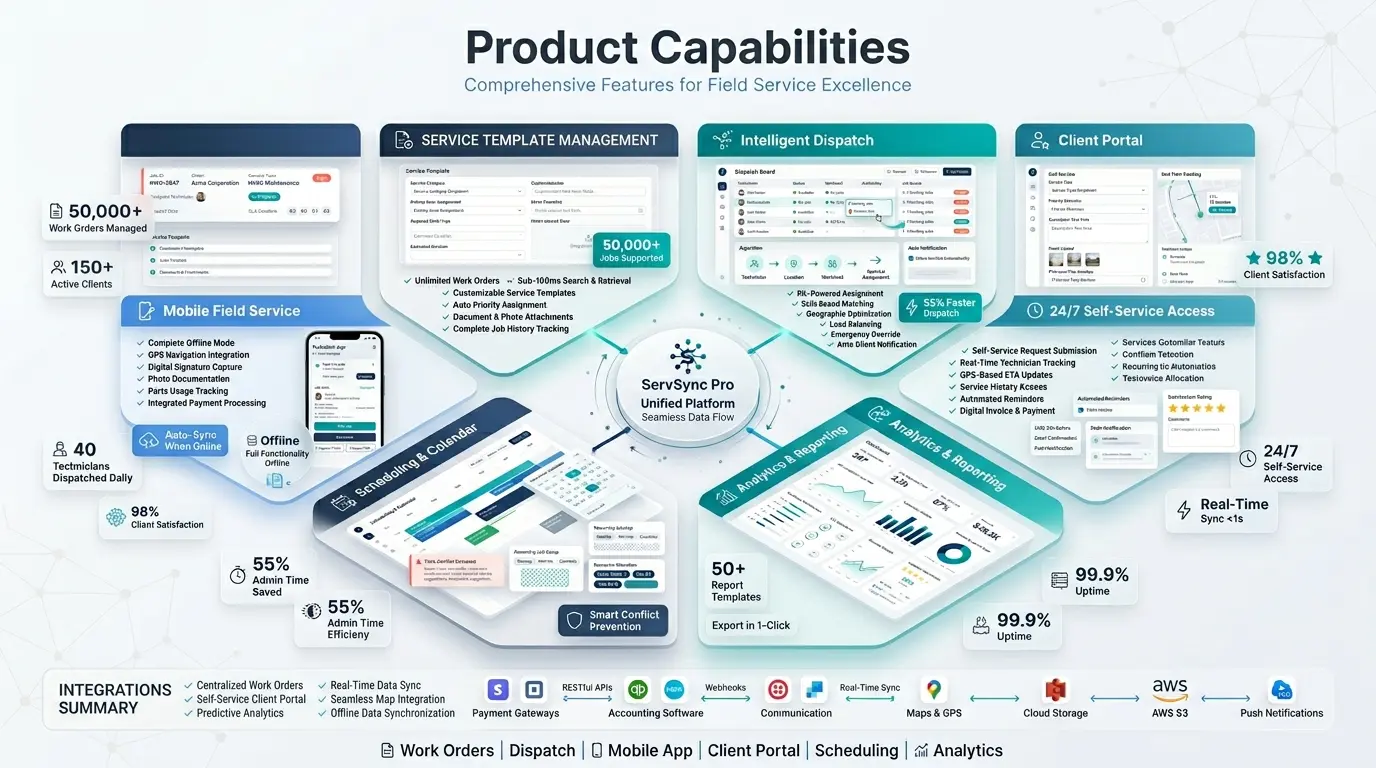
We engineered a modular capability suite that spans the entire maintenance lifecycle, ensuring seamless data flow from initial client request to final invoice reconciliation. The Work Order Management Engine serves as the central orchestration layer, processing 50,000+ jobs with intelligent priority routing and customizable service templates. The Intelligent Dispatch System employs machine learning to match technician skill sets, geographic proximity, and current load, while the Mobile Field Service App provides complete offline functionality, GPS navigation, and integrated payment processing. Complementing these is a robust Client Portal enabling self-service request submission, real-time technician tracking, and automated satisfaction feedback loops.
Functional Modules:
• Algorithmic technician assignment with automated client notifications
• Offline-capable mobile interface with digital signature capture
• Interactive scheduling calendar with conflict detection and resource allocation
• Real-time analytics dashboard tracking SLA compliance and revenue metrics
Performance & ROI
Six months post-deployment, the platform delivered quantifiable operational transformations that fundamentally elevated Apex’s service delivery model. By automating dispatch workflows and implementing algorithmic route optimization, we reduced dispatcher coordination time by 65% and eliminated 90 minutes of daily technician travel waste. The shift to digital, mobile-driven workflows compressed work order errors by 85% and accelerated average job completion by 40%. Client-facing improvements were equally pronounced: on-time arrival rates jumped from 68% to 94%, missed appointments fell by 78%, and overall satisfaction scores climbed from 3.4 to 4.8 out of 5.0.
Impact Metrics:
• 55% reduction in administrative overhead through workflow automation
• 38% increase in first-time fix rates via precision skill matching
• Billing cycle compression from 7 days to same-day execution
• Full ROI achieved within 6 months, delivering 340% of initial investment value in year one
Main Landing Page
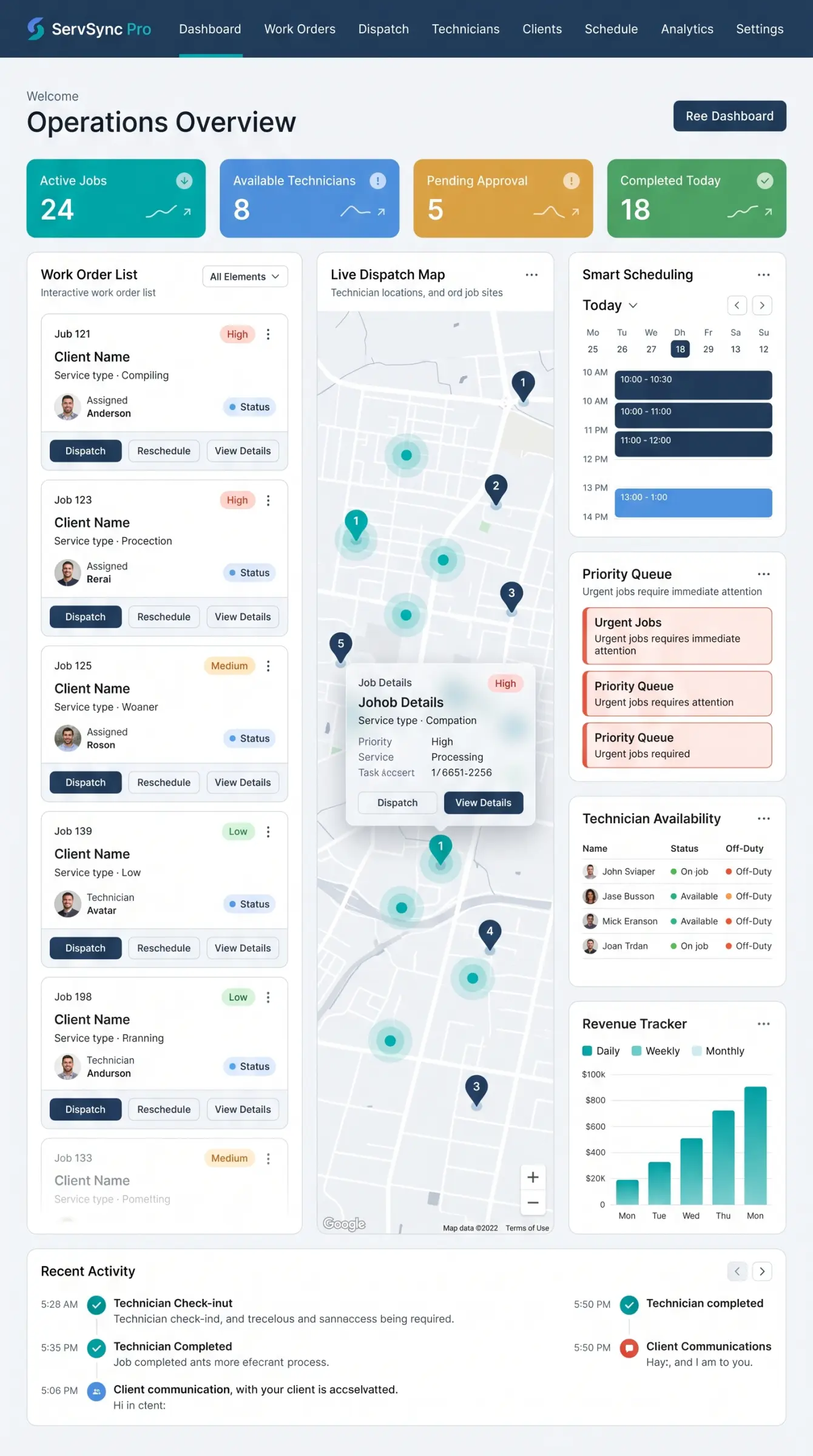
We designed the desktop interface as a centralized command center, prioritizing decision-ready intelligence for operations managers. The layout employs a refined light-theme aesthetic anchored in professional navy and vibrant teal, utilizing glassmorphism panels to reduce visual weight while maintaining strict data hierarchy. A modular grid system organizes active work orders, live GPS dispatch maps, and SLA compliance widgets into a single cohesive viewport. Advanced filtering matrices allow managers to segment jobs by urgency, location, and technician skill without cognitive friction. The conversion strategy centers on rapid execution: drag-and-drop assignment, one-click status propagation, and real-time KPI visualization. By minimizing interface clutter and maximizing actionable data density, the design ensures facility managers can coordinate large-scale maintenance operations with surgical precision.
Mobile Landing Page
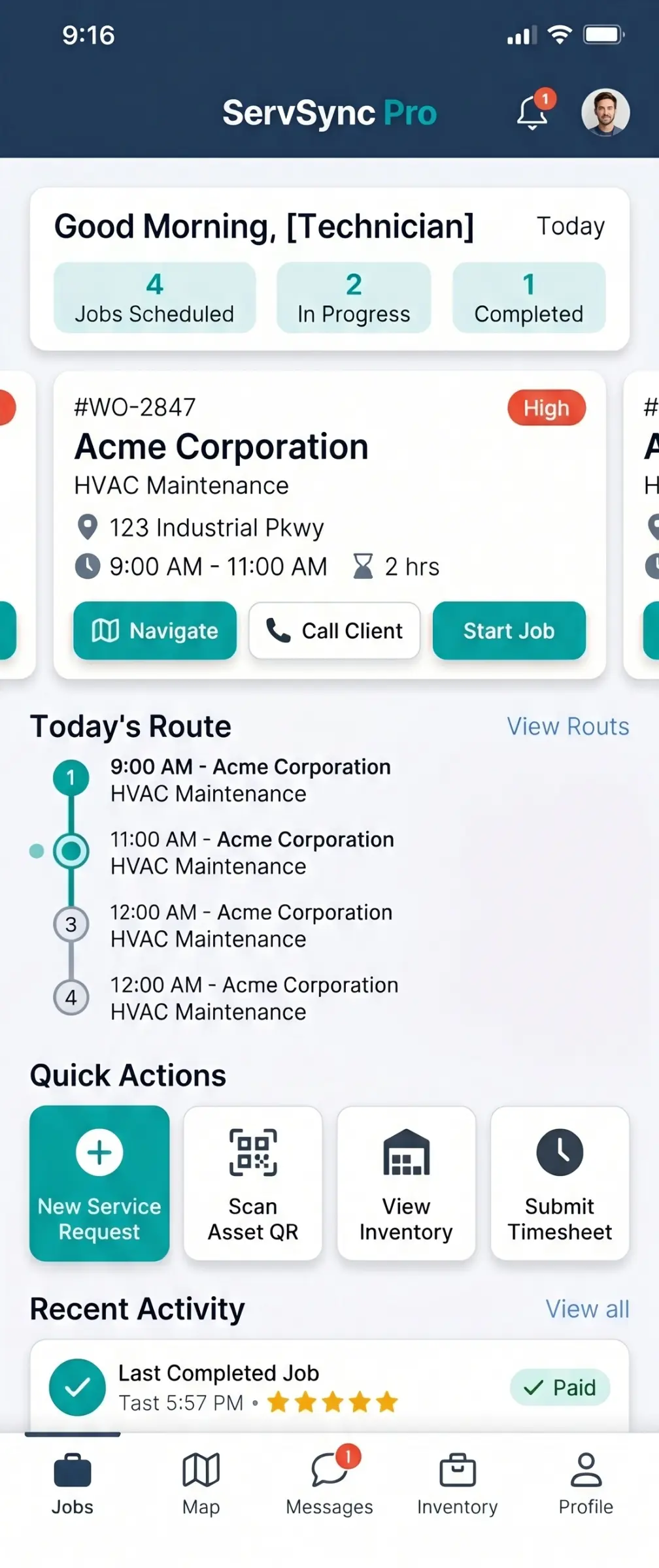
Recognizing the environmental constraints of field service, we engineered a mobile-first architecture optimized for thumb-driven interaction and intermittent connectivity. The interface strips away non-essential administrative elements, surfacing immediate job assignments, route optimization maps, and rapid status toggles through a vertically stacked card layout. We implemented swipeable job queues, voice-to-text logging, and QR asset scanning to minimize manual input during active maintenance windows. Touch targets exceed 44x44pt accessibility standards, with high-contrast visual states ensuring legibility under direct sunlight or poor lighting. Offline data caching guarantees full functionality including digital signature capture, photo documentation, and inventory deduction—regardless of cellular coverage. The design maintains strict visual cohesion with the desktop platform, creating a seamless operational continuum from dispatch center to job site.