Introduction: The Revenue Cost of Every Millisecond
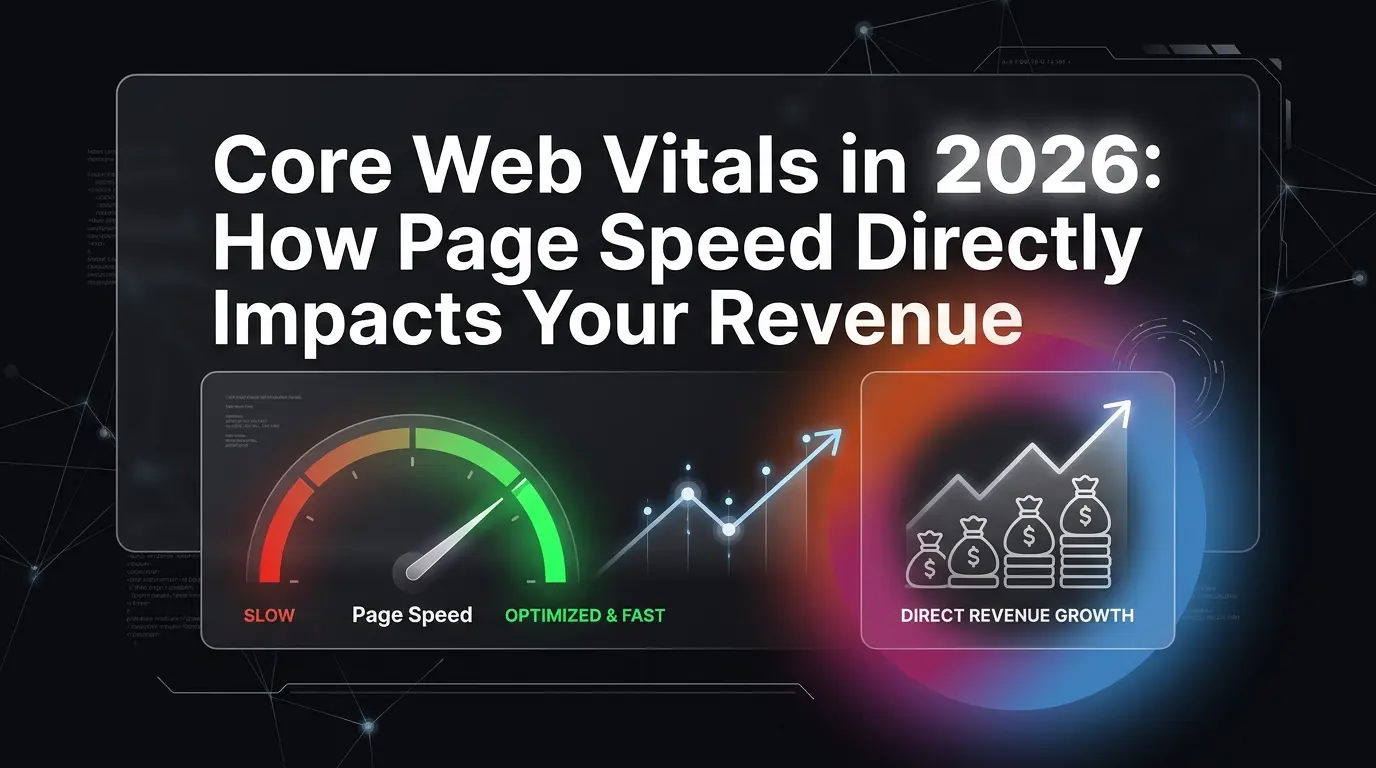
Page speed is not a vanity metric. It is a revenue metric. Research from Google, Deloitte, and Akamai consistently demonstrates a direct, quantifiable relationship between page load time and conversion rates. Every 100 milliseconds of improvement in page speed increases conversion rates by approximately 1 percent. For businesses generating significant online revenue, this translates to hundreds of thousands in additional annual income.
In 2026, Google's Core Web Vitals have become the definitive performance standard. These metrics, Largest Contentful Paint (LCP), Interaction to Next Paint (INP), and Cumulative Layout Shift (CLS), are confirmed ranking signals that directly influence your organic search visibility. But their impact extends far beyond SEO. They measure the fundamental user experience qualities that determine whether visitors stay, engage, and convert, or bounce and go to your competitor.
At The DIGIT HQ, we specialize in performance engineering that delivers measurable business outcomes. This article breaks down the data behind the performance-revenue relationship and provides a framework for calculating the ROI of performance optimization investments.
The Data: Performance and Revenue Correlation
Let us look at the research that quantifies the relationship between page speed and business outcomes:
Conversion Rate Impact
A Deloitte study of mobile sites found that a 0.1 second improvement in site speed resulted in a 8.4 percent increase in conversions for retail sites and a 10.1 percent increase for travel sites. Google's own research shows that as page load time increases from 1 second to 3 seconds, the probability of bounce increases by 32 percent. From 1 second to 5 seconds, the probability of bounce increases by 90 percent.
Revenue Per Session
Amazon famously calculated that every 100ms of latency cost them 1 percent in sales. While your business may not operate at Amazon's scale, the proportional relationship holds. If your website generates 100,000 pounds per month and your average page load time is 4 seconds, reducing it to 2 seconds could realistically increase monthly revenue by 7,000 to 15,000 pounds based on published conversion rate research.
Understanding Each Core Web Vital
Largest Contentful Paint (LCP): The First Impression
LCP measures how long it takes for the largest visible content element to render on screen. This is the metric that captures the user's perception of "how fast does this page load?" Google considers LCP scores under 2.5 seconds as "good," between 2.5 and 4 seconds as "needs improvement," and above 4 seconds as "poor."
The most common causes of poor LCP are slow server response times, render-blocking CSS and JavaScript, unoptimized images, and client-side rendering that delays the display of primary content. Our engineering team addresses each of these at the infrastructure level through server-side caching, critical CSS inlining, image optimization pipelines, and strategic preloading.
Interaction to Next Paint (INP): The Responsiveness Metric
INP replaced First Input Delay (FID) as the responsiveness Core Web Vital in March 2024. While FID only measured the delay of the first interaction, INP measures the responsiveness of all interactions throughout the page lifecycle. This is a much more comprehensive metric that captures the real-world experience of using your site.
Poor INP scores are almost always caused by JavaScript execution that blocks the main thread. Every click, tap, and keyboard interaction must be processed, and if the main thread is busy executing a long JavaScript task, the browser cannot respond to the user's input until that task completes. This creates the "lag" or "jank" that frustrates users and drives them away.
Cumulative Layout Shift (CLS): The Stability Metric
CLS measures the visual stability of your page during loading. Have you ever tried to click a button on a website, only to have the page shift at the last moment, causing you to click on something else? That is a layout shift, and it is one of the most frustrating user experiences on the web.
CLS is caused by images without dimensions, dynamically injected content, web fonts that cause text reflow, and ads or embeds that load asynchronously and push content around. The fix is straightforward in principle (reserve space for all dynamic content before it loads) but requires careful engineering to implement without affecting page functionality.
The SEO Impact: Rankings and Visibility
Core Web Vitals are confirmed Google ranking signals. While content relevance and backlink authority remain the primary ranking factors, Core Web Vitals serve as a tiebreaker between pages with similar content quality. In competitive niches where dozens of pages target the same keywords, performance can be the difference between page one and page two.
Our SEO team works alongside our performance engineering team to ensure that technical performance optimization and search visibility optimization are aligned. There is no point in ranking first if your page loads so slowly that visitors bounce before they see your content.
Calculating Your Performance ROI
To calculate the potential ROI of performance optimization for your business, you need four numbers: your current monthly revenue from web traffic, your current average page load time (available from Google Analytics or PageSpeed Insights), your target page load time after optimization, and the expected conversion rate improvement based on published research (approximately 1 percent per 100ms improvement).
For most businesses, the ROI of performance optimization is achieved within the first two to three months. The investment in engineering time is a one-time cost. The revenue increase is permanent and compounds as your traffic grows.
Our Performance Engineering Approach
At The DIGIT HQ, we approach performance optimization as an engineering discipline, not a checklist exercise. We begin with a comprehensive performance audit that measures your current Core Web Vitals scores, identifies the specific bottlenecks causing poor scores, and quantifies the business impact of each issue.
We then implement optimizations in priority order, starting with the changes that deliver the largest performance improvement for the least engineering effort. Common optimizations include image format conversion and compression, critical CSS extraction and inlining, JavaScript bundle splitting and lazy loading, server-side caching implementation, CDN configuration and asset optimization, database query optimization for faster server response times, and font loading optimization.
Case Study Results
Our performance optimization work consistently delivers dramatic improvements. Across our portfolio, our Conversion Rate Optimization engineering has delivered measurable improvements in both Core Web Vitals scores and business metrics for clients across industries.
Taking Action
If your website's Core Web Vitals are not in the "good" range (green scores in Google Search Console), you are leaving money on the table. Every day that your site loads slowly is a day that potential customers are bouncing to your faster competitors.
Contact The DIGIT HQ for a complimentary performance audit. We will measure your current Core Web Vitals, identify your biggest performance bottlenecks, and provide a realistic estimate of the revenue impact of fixing them.