Introduction: The Shift From Prompts to Autonomous Agents
In 2024, businesses discovered ChatGPT. In 2025, they started building prompt-based automations. In 2026, the leading companies are deploying fully autonomous AI agents that operate as a digital workforce, executing complex multi-step workflows with minimal human intervention.
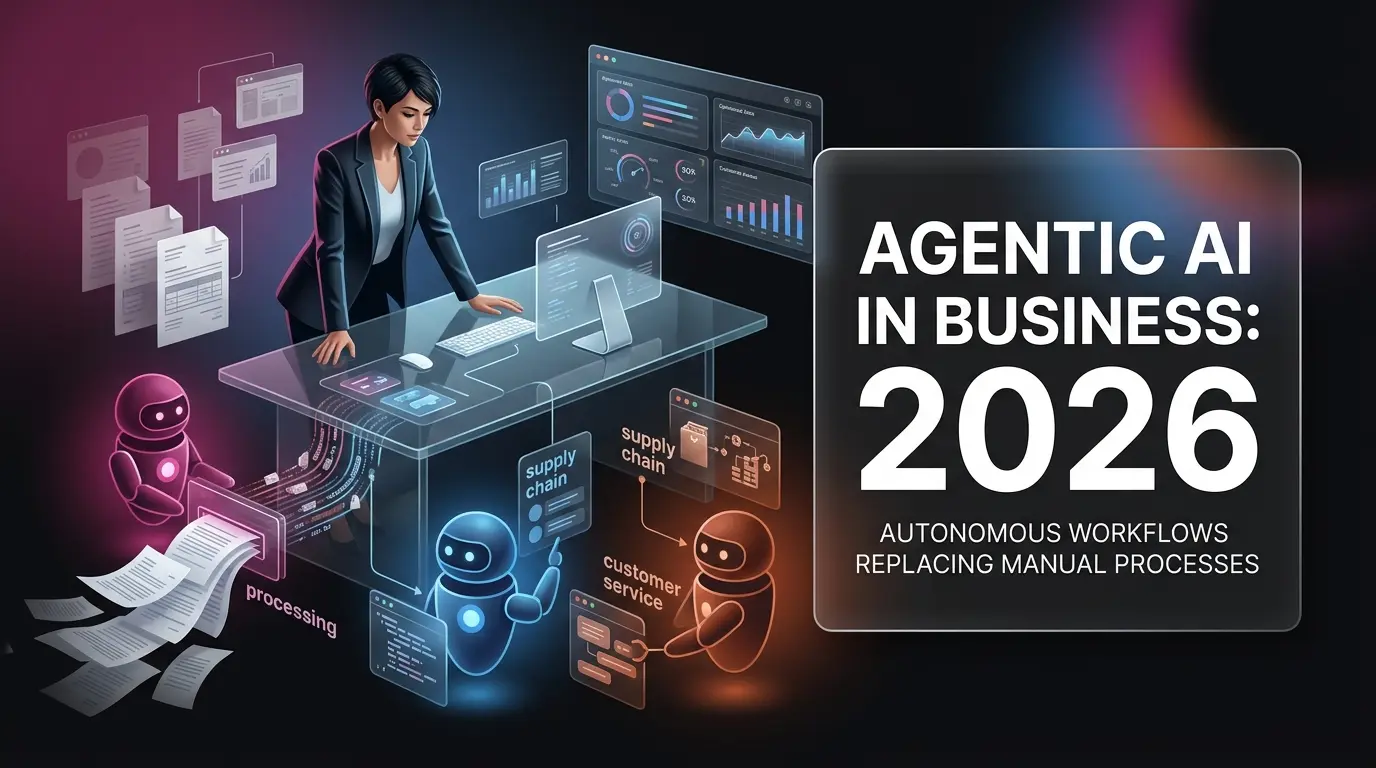
This is not science fiction. It is the operational reality of forward-thinking businesses that have embraced what we call Agentic AI: artificial intelligence systems that can reason, plan, execute, and self-correct across complex business processes. These agents do not just answer questions. They take actions, make decisions within defined boundaries, and deliver outcomes that previously required entire teams of human operators.
At The DIGIT HQ, we architect and deploy these agentic systems for businesses across industries. This article breaks down what Agentic AI actually means in practice, how it differs from traditional automation, and how your business can leverage it to achieve a genuine competitive advantage.
What Makes an AI Agent "Agentic"?
The term "agentic" refers to AI systems that exhibit agency: the ability to act independently toward a goal. Unlike traditional chatbots or simple automation scripts, an agentic AI system possesses four critical capabilities:
- Reasoning: The agent can analyze a situation, weigh options, and choose the optimal course of action based on context, constraints, and objectives.
- Planning: The agent can break a complex goal into sequential steps, identify dependencies between tasks, and create an execution plan before taking action.
- Tool Use: The agent can interact with external systems: databases, APIs, file systems, web browsers, email servers, and other software tools. This is what transforms a language model into a functional worker.
- Self-Correction: When an action fails or produces unexpected results, the agent can detect the failure, analyze what went wrong, and retry with an adjusted approach. This feedback loop is what separates agents from brittle scripts.
Architecture of an Enterprise AI Agent
Building a production-grade AI agent is not about connecting a language model to an API. It requires a carefully designed architecture that handles reasoning, memory, tool orchestration, and error recovery.
Our AI Development and Agentic Logic Development service follows a structured approach that we call the Cognitive Blueprint. Every agent we build consists of five layers:
Layer 1: The Reasoning Core
At the heart of every agent is a large language model (LLM) that serves as the reasoning engine. We select the optimal model based on the specific requirements of the task: Claude for complex reasoning and nuanced writing, GPT-4 for structured data processing, and Gemini for tasks that require deep integration with Google's ecosystem. The model selection is not arbitrary. It is a technical decision based on benchmarks, cost analysis, and production testing.
Layer 2: The Memory System
Effective agents need memory: both short-term (within a single task execution) and long-term (across multiple sessions and interactions). We implement vector databases for semantic memory retrieval, allowing agents to recall relevant context from thousands of previous interactions without hitting token limits. This is what allows an agent to "learn" from experience and improve its performance over time.
Layer 3: The Tool Registry
Tools are the hands and feet of an AI agent. Every external system the agent needs to interact with is wrapped in a standardized tool interface with input validation, error handling, and rate limiting. We build custom tool integrations for CRMs, ERPs, databases, email systems, payment platforms, and internal APIs. The agent discovers and selects tools dynamically based on the task at hand.
Layer 4: The Orchestration Engine
For complex workflows that require multiple agents working in coordination, we build orchestration layers that manage task delegation, parallel execution, and result aggregation. Think of this as the "project manager" for your AI workforce: it assigns tasks to specialized agents, monitors their progress, and ensures the final output meets quality standards.
Layer 5: The Safety Layer
Every agent operates within strict guardrails. We implement Role-Based Access Control (RBAC) for AI agents, limiting what data they can access and what actions they can take. We build "sandbox" execution environments where agents can perform tasks without risking production data integrity. And we implement comprehensive audit logging so every agent action is traceable and reviewable.
Practical Use Cases: Where Agentic AI Delivers ROI
Agentic AI is not a solution looking for a problem. It is a powerful capability that delivers measurable returns in specific business contexts. Here are the use cases where we see the highest ROI:
1. Autonomous Customer Support Operations
An AI agent that can resolve 80 percent of customer support tickets without human intervention. The agent reads the ticket, accesses the customer's account data, diagnoses the issue, takes corrective action (refunds, account modifications, configuration changes), and sends a personalized response. Escalation to human agents happens only for genuinely complex cases.
2. Intelligent Lead Qualification and Nurturing
An agent that monitors inbound leads from multiple channels (website forms, email, social media), enriches lead data from external sources, scores leads based on your ideal customer profile, and autonomously initiates personalized outreach sequences. This agent replaces the first two hours of work that your sales team does every morning.
3. Financial Data Processing and Reporting
Agents that pull data from accounting systems, bank feeds, and payment platforms, reconcile transactions, flag anomalies, and generate executive-level financial reports on a daily basis. For businesses processing hundreds of transactions daily, this eliminates hours of manual bookkeeping and reduces error rates to near zero.
4. Content Operations at Scale
For media companies and content-driven businesses, agents that can research topics, draft articles, optimize for SEO, schedule publications, and distribute content across channels. These agents do not replace writers. They handle the operational overhead that surrounds content production, freeing your creative team to focus on strategy and quality.
Implementation Strategy: From Pilot to Production
Deploying agentic AI in your business is not a "flip the switch" operation. It requires a phased approach that builds confidence, validates assumptions, and scales gradually. Our Enterprise Prompt Engineering team follows a four-phase methodology:
- Phase 1 - Operational Audit (2 weeks): We map your current workflows, identify automation candidates, and quantify the time and cost of each manual process.
- Phase 2 - Agent Prototyping (4 weeks): We build a proof-of-concept agent for your highest-ROI use case, test it against real data, and measure its accuracy and reliability.
- Phase 3 - Production Deployment (4-8 weeks): We harden the agent for production use, implement monitoring, error handling, and safety guardrails, and deploy it alongside your existing workflows with human-in-the-loop oversight.
- Phase 4 - Scaling and Optimization (ongoing): We expand the agent's capabilities, add new tool integrations, and continuously optimize its reasoning chains based on production feedback.
Case Studies: Agentic AI in Action
Our approach to agentic AI is best illustrated through real implementations. The Meridian Axis project demonstrates how we built autonomous data processing pipelines that handle complex multi-source data aggregation with intelligent error recovery and adaptive processing strategies.
The CloudPulse Observability Engine showcases our ability to deploy AI agents in mission-critical monitoring environments, where autonomous agents detect anomalies, correlate events across distributed systems, and trigger remediation workflows without human intervention.
The Cost of Not Automating
Every manual process in your business has a compound cost: the direct cost of labor, the opportunity cost of talent wasted on repetitive tasks, the error cost of human mistakes, and the scaling cost of needing to hire linearly as your business grows. Agentic AI breaks this linear relationship between growth and headcount.
The businesses that deploy agentic AI in 2026 will have a structural cost advantage over those that wait. Not because the technology is cheap, but because the operational efficiency it creates compounds over time. An agent that saves your team 20 hours per week today saves over 1,000 hours per year. And unlike a human employee, the agent gets faster and more accurate over time, not slower.
Getting Started
If you are evaluating agentic AI for your business, the first step is an honest assessment of your current operations. Where are your teams spending time on repetitive, rule-based tasks? Where are errors most costly? Where would faster execution give you a competitive advantage?
At The DIGIT HQ, we offer a complimentary Operational Efficiency Audit for businesses considering AI automation. We will map your workflows, identify the highest-ROI automation candidates, and provide a realistic implementation timeline and cost estimate. Contact us to schedule your audit.